Shareholder Activism – Whither Board Leadership?

By Johnson Manyakara
Simply put, a shareholder activist is an investor who attempts to use his/her rights as an owner of a publicly-quoted company to seek dialogue and/or change in an entity-attempts to gain control of the entity and even replace management. Typically, the focus is on corporate strategy, balance sheet issues, operations, boards of directors, senior management and M&A activity.
In the 1980s and 90s, the term “activist shareholder” was synonymous with “corporate raider”-scary stuff indeed.
How Shareholder Activism Presents?
Shareholder activism is increasingly coming from mainstream institutional investors who engage companies through-
- Voting at AGMs or by proxy;
- Writing letters to Investor Relations Departments or to Corporate Secretaries;
- Filing Resolutions (e.g. petitioning companies for AGM agendas);
- Having In-Person meetings/dialogues; and
- Divesting-sending a message by selling their shares.
Hedge Funds are the most ruthless, focusing on financial engineering, while active Mutual Funds focus on securing their long-term investments.
These heavily engaged investors are often extremely knowledgeable about the company. Furthermore, they have deep pockets and smart teams, often equipped with analytical tools that can outstrip even the most well-meaning board.
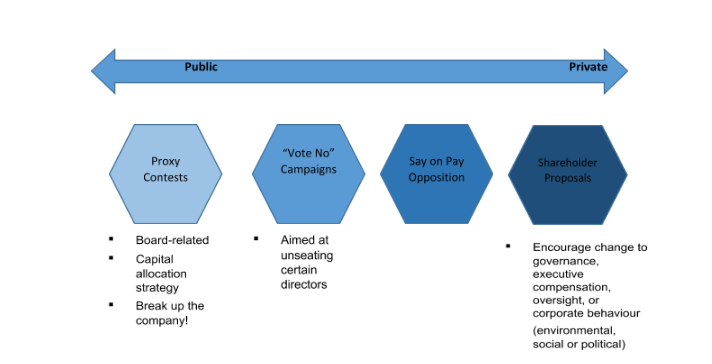
Shareholder activism comes in many shapes or forms. Their activities can generally be broken down into four major categories.
Growth of Shareholder Activism
Like it or not, shareholder activism is getting prevalent and increasing, particularly in the Western world. There were 758 reported shareholder campaigns against public companies in 2016-nearly double the number in 2013. There are probably at least as many that are never covered by the press because of “out-of-court settlements” between the activists and the target company’s board.
Shareholder activists, meanwhile, manage capital of more than $170 billion, compared with less than $3 billion in 2000.
Which Companies Are Often Targeted?
Most shareholder activists tend to set their sights on companies with the following issues:
- Poor Governance and Board Practices;
- Under performance;
- “Zombie” directors (those directors who did not receive majority shareholder support, but somehow remain on the board);
- Combined Chairman/CEO;
- Non-Independent Directors;
- Lack of shareholder rights (e.g. right to call a special meeting, proxy access, etc.);
- Executive Compensation issues;
- Ongoing concerns regarding executive pay-typically spurred by media scrutiny;
- Shareholder proposal received majority support but your board did not implement it;
- Significant media criticism of product launches, recent mergers, acquisitions; and
- Identified as an outlier in environmental or social practices.
Is Your Company “On the Ball”?
Very few companies in Southern Africa, let alone in Zimbabwe, have established Investor Relations Units or retained an Independent Expert that supports them in this increasingly strategic Board Leadership area. It is this Unit, or Independent Expert, that will monitor any suspicious activity or engagement pointing towards the company being targeted by shareholder activism. Vigilance in this area is paramount.
Best practice recommends the following steps to be taken when analysing the company’s investor base;
- Recognise the warning signs;
- Educate your board;
- Know your existing shareholder base;
- Form an internal Activist Awareness/Response Team that meets regularly; and
- Have a game plan in place for a response.