Boards and Organisational Performance

The organisation’s ability to deliver against its mandate – whether it is financial success and/or success in the provision of basic services, such as garbage collection, clean water, electricity, telecommunications, transportation, health and education, is every Board’s dream. However, this will not come on its own, like manna from heaven. It takes deliberate effort by Boards and sound performance management processes, sometimes with the help of expert advice from consultants.
This article is a high level exposé of typical errors in strategic performance management, the typical performance management cycle and provisions of the Public Entities Corporate Governance Act (PECGA), in relation to performance management processes in public entities. It focuses on performance management at Board level and at Senior Management level (i.e. the CEO and his or her direct reports).
Typical Errors
Readers will be able to recognise the typical errors in performance management below:
- No strategic plan in place.
- Strategy not sufficiently clear or known for translation into Key Performance Indicators (KPIs).
- Insufficient communication resulting in limited understanding of business context, including strategic objectives.
- Translation of strategy into KPIs not properly done. For example, it is merely a cascade into functional structures without considering value chain or customer needs.
- Managers not using KPI are to actively manage the performance of individuals and teams – KPIs not kept alive, the spirit being sheer compliance and not passion.
- Staff not expected to take full ownership and accountability for delivery against KPIs.
- Nil or inconsistent management of consequence, both for good performance and/or poor performance.
The Performance Management Cycle
Typically, the Performance Management Cycle goes through the following steps:
- Business Planning (Strategic Plan & Business Plan);
- Communication; and
- Key Performance Indicators.
Business Planning
This is in the form of:
- A Strategic Plan: a plan that sets the company’s strategic direction and strategic priorities; and
- An Annual Business Plan: a more detailed plan that is distilled from the Strategic Plan, by Division/Department.
Communication
Alignment between the Board and Board members, between the Board and the CEO as well as the CEO and direct reports is key for effective Performance Management. This is achieved through communication of the company’s strategic thrusts and objectives for the planning period to all concerned.
Key Performance Indicators (KPIs)
Setting of KPIs is a key component of an effective performance management system – it answers the question: “What is the Board, individual Board members, the CEO and other members of Senior Management promising to deliver in a given period?”. KPIs are distilled from the company’s strategic objectives and the Board must demand that the KPIs be SMART:
- Specific and Stretching;
- Measurable;
- Aggressive yet Achievable;
- Relevant; and
- Timed and Tracked.
Balanced Scorecard
It is recommended that the KPIs be organised around 4 distinct perspectives to ‘Balance’ the previously dominant Financial perspective with 3 other perspectives, namely:
- Customer perspective;
- Internal Business perspective; and
- Learning and Growth.
Result? A BALANCED SCORECARD
Performance Reviews
- These are formal reviews of performance against KPIs (An External Expert can assist with a Sample Performance Evaluation Form).
- Ideally happen twice a year; mid-year and at the end of the year.
- Results in a performance rating.
Consequence Management
In a bid to build a high performance culture, ideally there should be appropriate consequences as follows:
- Satisfactory Performance: Attracting some form of reward (e.g. a performance bonus).
- Poor Performance: Initially attracting some form of counselling and, if performance doesn’t improve, this may result in separation.
Public Entities Corporate Governance Act (PECGA) Provisions
The diagram below encapsulates the strategic performance management processes in public enterprises, distilled from the PECGA.
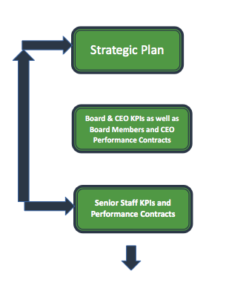
Illustration of strategic management processes distilled from PECGA
The Act also provides for:
- Performance Monitoring and Review; and
- Consequence Management.